


The heart of Japan is often found not in its neon-drenched metropolises or manicured temple gardens, but in the quiet interstitial spaces where humanity has, for millennia, maintained a delicate, reciprocal bond with the wild. These are the satoyama—the mosaic landscapes of cultivated fields, managed forests, and traditional villages that act as a crucial buffer between deep wilderness and human civilization.
Yet, like many rural corners of the developed world, this vital landscape is faltering. Decades of demographic shifts—the steady migration of youth to cities, leaving behind an aging populace—have turned carefully managed forests into overgrown thickets and vibrant communities into ghost towns. The crucial balance of the satoyama is tipping, and the wild is reclaiming land in an unmanaged, sometimes destructive, way.
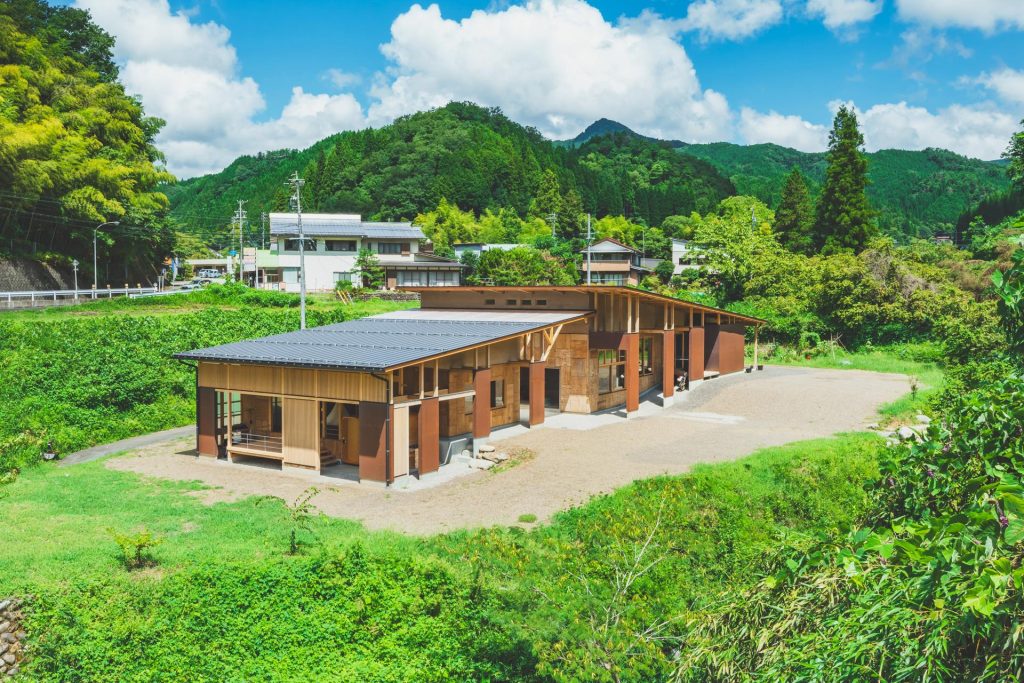
Gujo, a city nestled deep in the mountainous heart of Gifu Prefecture, feels like one of the last bastions of this vanishing way of life. Known for its pristine rivers—the lifelines of the region—and a deep-seated culture of craft and song. Every summer, this cultural heart beats loudest during the Gujo Odori, a 400-year-old traditional dance designated as a UNESCO Intangible Cultural Heritage. Held for over thirty nights, it is famous as a ‘dance you DANCE,’ where locals and visitors, regardless of skill, gather to participate in a profound act of community. But the dance is only one manifestation of Gujo’s spirit. The city is now also home to a quiet revolution, a quest for rewilding—both the land itself, and the people who travel here.
In Gujo, a handful of I-turners and passionate locals are embracing a new kind of adventure tourism: one that is not extractive, but preservative. Their mission is twofold: to save the satoyama through sustainable interaction, and, in the process, to help the weary, disconnected modern traveler find their own way back to the wild. This is the journey of rewilding, in Gujo.
The Predator’s Pact: Yassan and the Hunter’s Ethos
My initiation into the world of Gujo’s ecological balance began deep in the cedar forest with Yassan, a member of a hunters’ collective and the Satoyama conservation organization “Inoshika-chō.” An energetic, sharp-eyed man, Yassan made the i-turn—the move from city to country—around eleven years ago. Now, he is one of Japan’s most vocal proponents for a deeply misunderstood tradition: hunting.
“People in the city see hunting as cruel, as a blood sport,” Yassan explains, his voice a low, steady murmur as we crunch through the undergrowth. “But here, it is survival. It is conservation.”
The problem is one of imbalance. With wolves extinct in Japan and human populations retreating, wild deer and boar have multiplied unchecked. These animals, once part of the satoyama‘s rhythm, now overpopulate, devastating new growth forests, stripping bark from cedar trees, and decimating the agricultural fields that form the economic bedrock of the villages. They are, quite literally, eating the satoyama to death. The hunter, Yassan asserts, is now the land’s most vital predator.
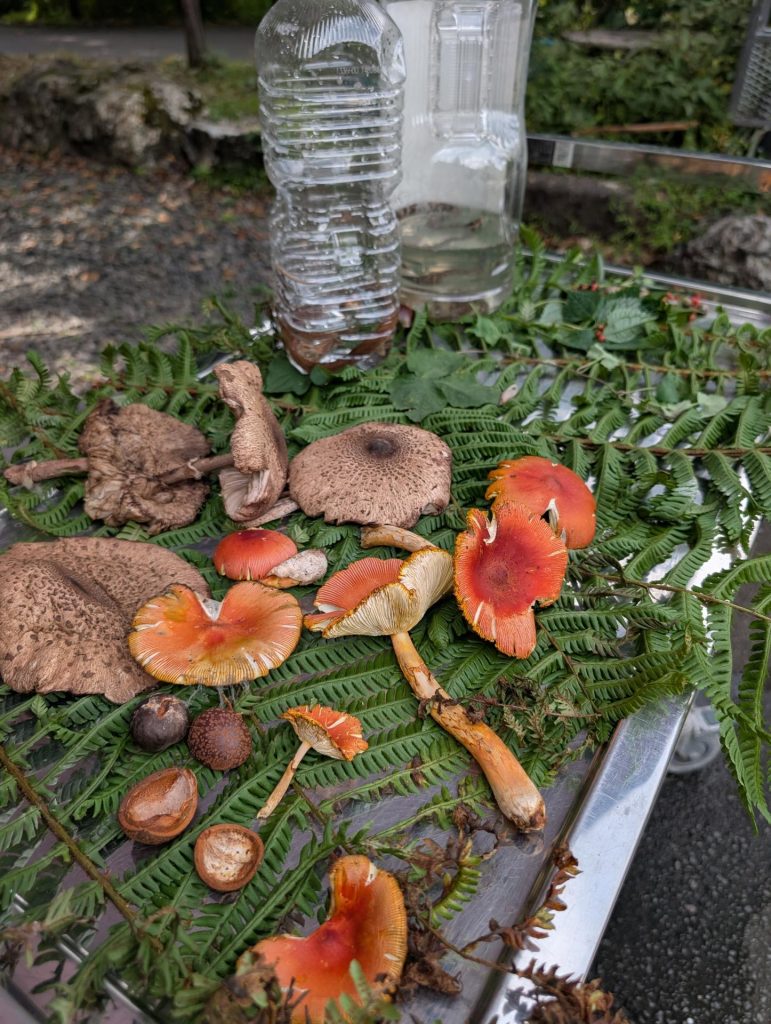
Yassan’s “hunting experience” is less about the kill and more about reconnecting with the instincts and knowledge that allowed humans to live in harmony with this landscape for millennia. We begin with the foundational skills: learning to read the forest floor—the faint hagi (scrapes) left by a buck’s antlers, the depth of a hoofprint in the soft earth, the faint, moss-covered trail where a boar rooted for tubers. We forage for wild foods, a sensory exercise in recognizing the forest’s hidden pantry, a reminder that sustenance is not just purchased, but earned.
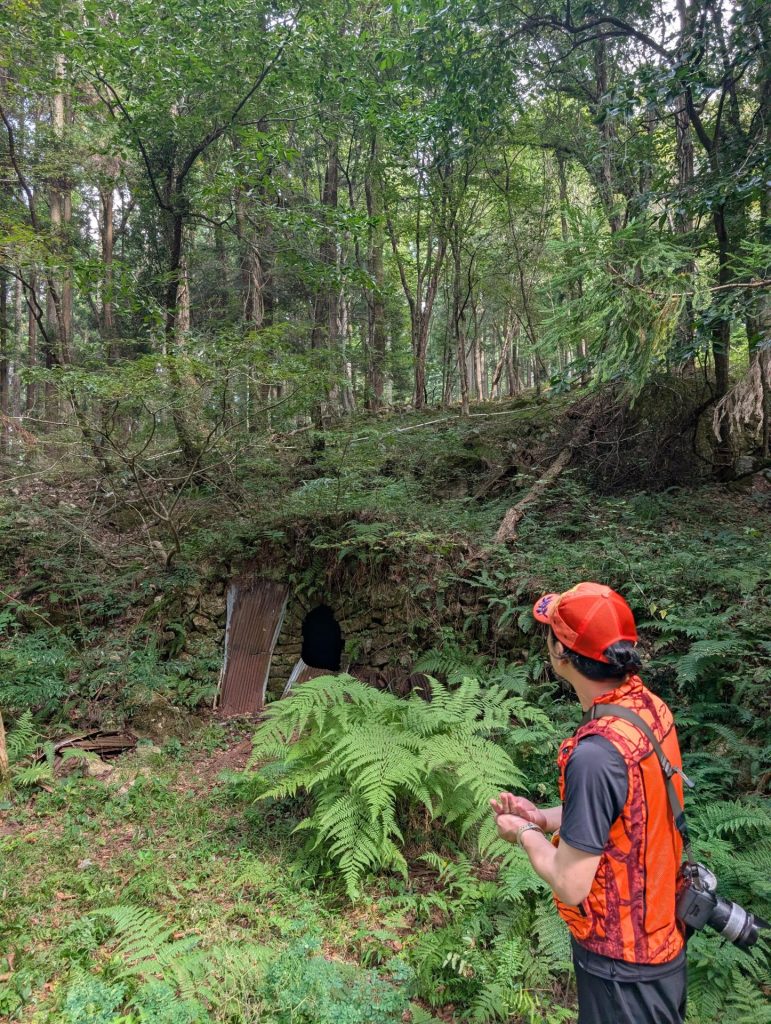
Then comes the physical training. We practice shooting with a BB gun, an exercise in patience and precision that teaches respect for the weapon and the target. But the real lesson is in the stalking. With Yassan, we set out, moving through the forest with painstaking silence, our bodies mimicking the slow, deliberate movements of the deer we seek. It is a profound, meditative experience that forces the mind to quiet and the senses to sharpen. For someone whose daily life is dictated by the immediate demands of a screen, this enforced slowness—this need to observe rather than act—is a powerful form of rewilding the human mind.
The culmination of the experience is the Gibier BBQ. On the day I joined, Yassan and his apprentices had successfully culled a young deer. The lesson that followed was not merely butchery, but a solemn ceremony. We learned to clean the animal, transforming a wild creature into a respectful meal, ensuring no part was wasted. Later, under the light of a charcoal grill, the resulting gibier (wild meat) was tender, rich, and utterly pure—the true taste of the forest, a profound reminder of the link between life, death, and human sustenance. Eating this meat, knowing its history and purpose, is perhaps the most authentic way to support the satoyama: not just by managing the population, but by closing the ancient loop of the ecosystem.

Designer’s Retreat: Yoshito and the River Sanctuary
Leaving the shadows of the deep forest, the journey takes me to the banks of a crystalline river, to a small village where a different kind of rewilding is underway. Here, I meet Yoshito, a man who once lived in Tokyo and, after experiencing the frenetic pace and abstract world of life as a designer there, chose to trade it all for a life of tangible beauty in the Gujo countryside.
“The city burns you out,” Yoshito says, his demeanor calm and reflective, a distinct contrast to the hustle he left behind. “Here, the river sets the rhythm. You can’t rush the water.”
His accommodation, Higenos, is a masterpiece that perfectly encapsulates his journey. It is a stunning example of his design philosophy—minimalist, elegant, and perfectly integrated into the satoyama. The timber structure seems to melt into the surrounding greenery, yet every detail, from the handmade ceramics to the strategically placed windows, is clearly the work of a highly skilled aesthetician. It offers the comfort of modern life while demanding constant attention to the natural world outside.
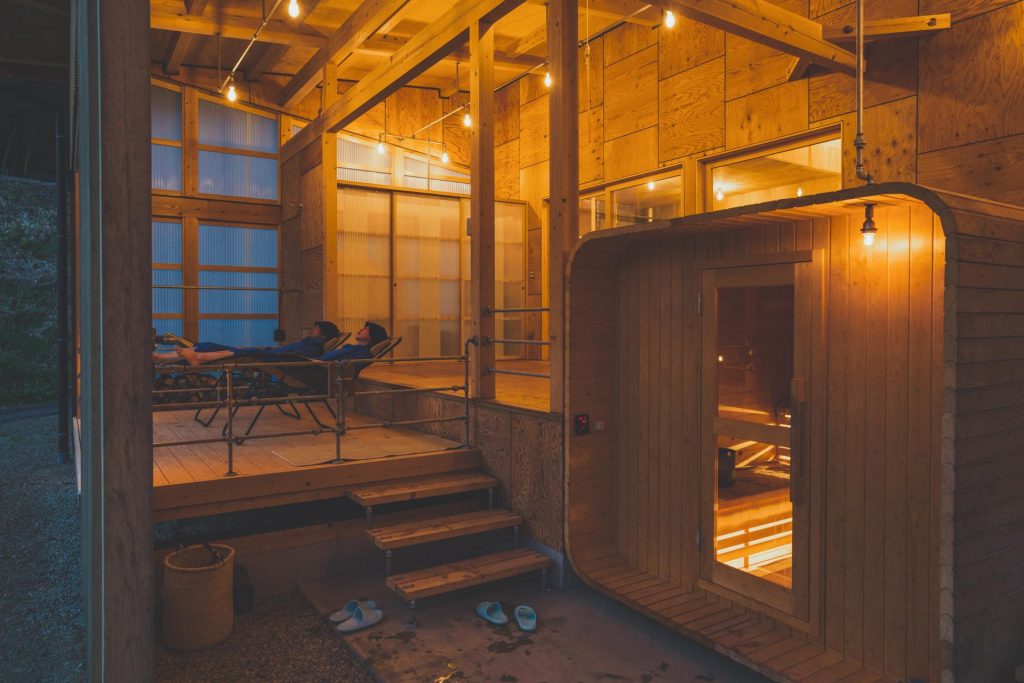
The true highlight, however, is the sauna and river experience. Built near the water’s edge, the sauna built near the water’s edge is a blissful sanctuary. After the heat has worked its magic, the required cold plunge is not a chilled barrel, but the icy embrace of the river itself. Stepping off the bank and submitting to the current is a shock to the system, a baptism of pure, mountain-fed water. The contrast is elemental, a powerful, almost spiritual way to reset the nervous system. The river is the pulse of the village, and by using it as a cold plunge, Yoshito connects his guests directly to that vital energy.
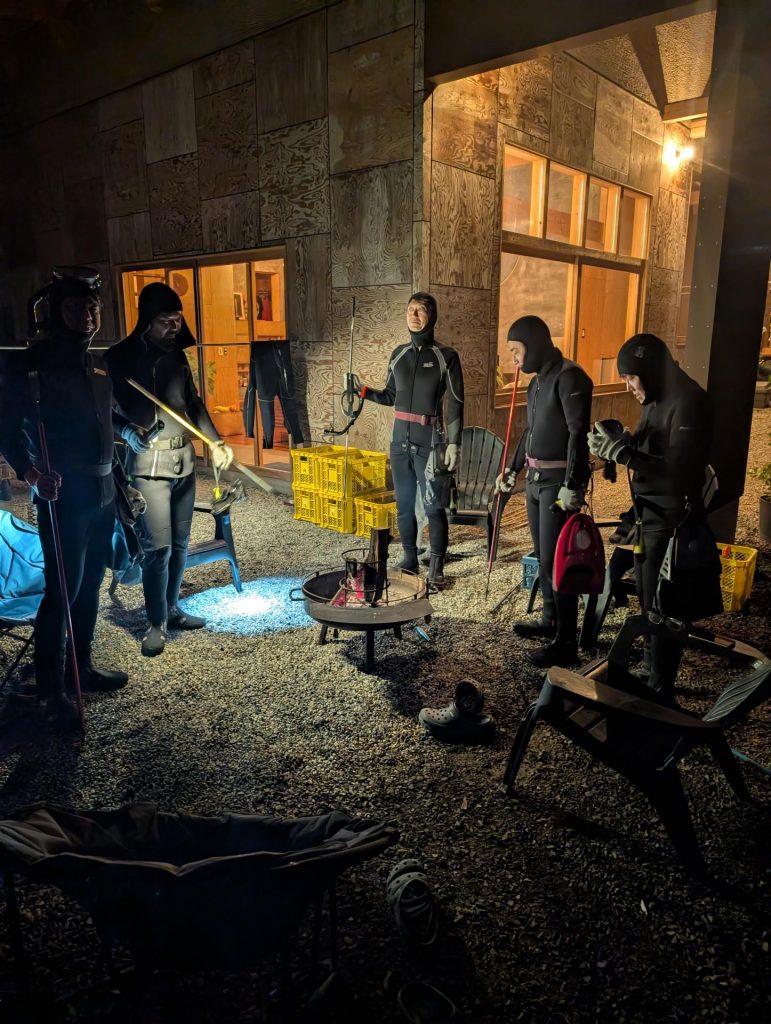
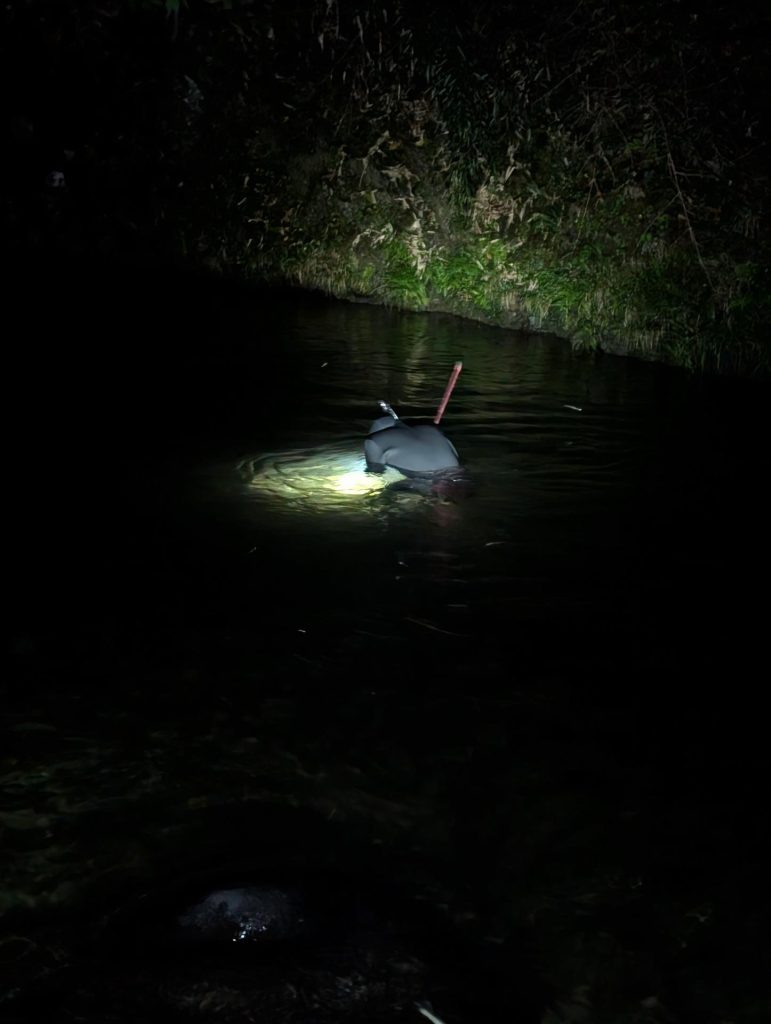
As the sun sets and the fireflies begin their silent dance, Yoshito reveals his other passion: night spearfishing for Ayu (sweetfish). The Ayu, highly prized in Japan, are a marker of river health, and Gujo’s rivers are famous for them.
Donning wetsuits and snorkels, we step into the darkness, illuminated only by our powerful headlamps. Submerged, the world transforms. The noise of the village disappears, replaced by the hushed sound of the current and the magnified clatter of river stones. The headlamp beam cuts through the clear water, catching the flash of silver as the Ayu hide near the rocks. There is something primal and exhilarating about snorkeling in a river at night—a sensory overload of cold, motion, and sudden visibility.
Yoshito is a master. He moves with the fluid grace of a river creature, his spear darting out with practiced, efficient accuracy. In just over an hour, he catches nearly twenty fish, ensuring only what is needed for the following day’s meal. The thrill of the hunt is palpable, even for an amateur like me; I manage a meager four fish, proof that the skills of the satoyama are not easily acquired. The spearfishing is not merely a fun activity; it is a demonstration of resource stewardship—the deep understanding of when and how to take from the river while ensuring its continued abundance.
Pedaling Through the Past: Segi-san and the Community Heartbeat
To truly understand the satoyama, one must understand its culture, and for that, there is Segi-san. The son of a famous local Ayu fisherman, Segi-san has the river in his blood, but his chosen path is to be a bridge between the past and the future through bike guiding.
“My father’s generation preserved the river with their nets,” Segi-san tells me as we prepare our bicycles. “My generation must preserve the spirit and the story of the community.”
Our cycling discovery takes us not along the tourist trails, but deep into the winding backroads of the village, where time seems to have paused. Segi-san is a patient and passionate historian. He points out ancient stone markers, reciting the haiku and folk songs that were written here centuries ago—poems that celebrate the turning of the seasons, the bounty of the harvest, and the simple beauty of a mountain stream. He paints a picture of a community held together by shared cultural experiences, showing how the satoyama is as much a cultural landscape as a physical one.
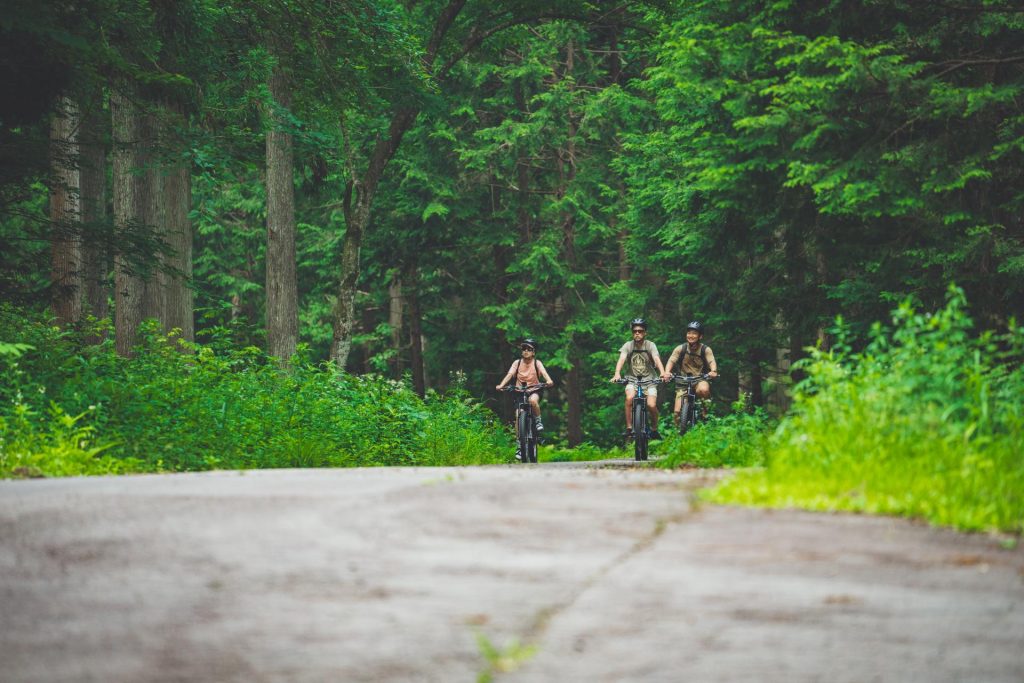
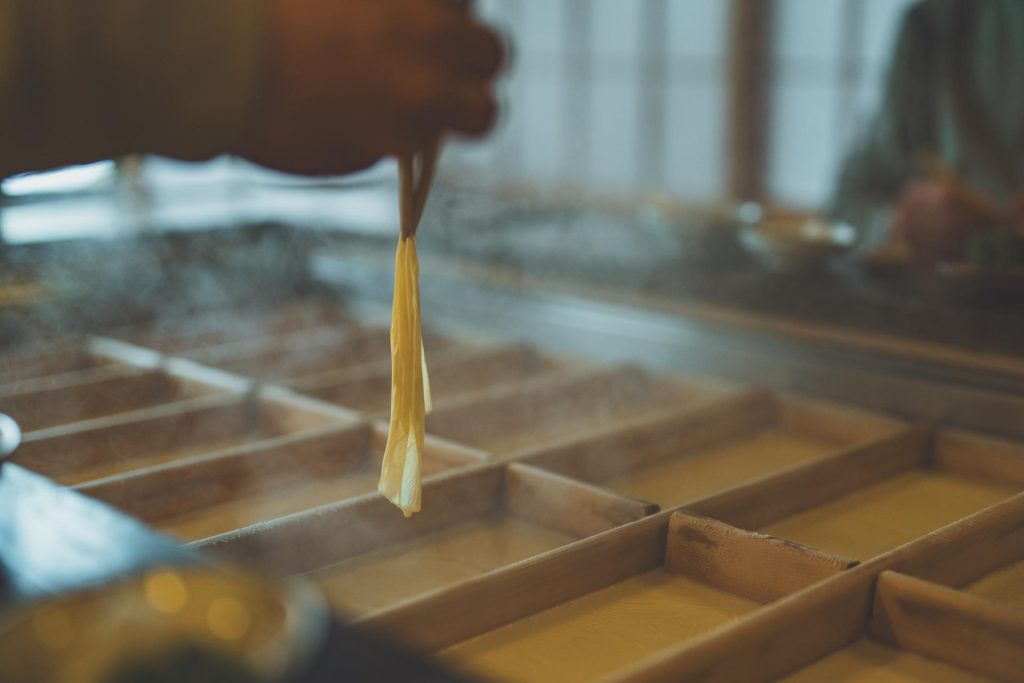
The bike tour is a sensory feast, punctuated by key stops that anchor the community. We visit a small, local craft tofu factory, a place where traditional methods have been passed down for generations. The air is warm and moist, smelling faintly of soybeans and mountain water. Here, we sample fresh Yuba (tofu skin), a delicate, creamy layer that melts on the tongue, its purity reflecting the quality of the ingredients and the dedication of the maker.
The most moving stop is the local general store run by an old couple who have been its keepers for over 50 years. The shop is a cluttered, comforting hub, selling everything from sake to sewing thread. Sitting with the couple, sipping green tea, we listen to their stories—tales of a lifetime spent watching the satoyama community ebb and flow. This tiny shop is more than a commercial enterprise; it is the physical nexus of the village’s communication, gossip, and collective memory. For Segi-san, ensuring this shop and its custodians remain viable is as crucial to the preservation of the satoyama as managing the deer population.
The Journey Complete
Yassan, Yoshito, and Segi-san represent the tripartite solution to the decline of the satoyama: ecological management, sustainable living, and cultural preservation. They are not merely selling adventure tours; they are selling a model for survival, a vision of how modern, conscious tourism can directly feed the communities and environments it relies upon.
My time in Gujo was a profound lesson in the meaning of rewilding. It is not just about letting the land go, but about re-engaging with it mindfully. It is about understanding that we are, in fact, an essential part of the ecosystem—a predator when necessary, a steward of the river, and a custodian of the culture.
As I left Gujo, the noise of the city already felt intrusive, its demands abstract. The silence of the forest floor, the shock of the cold river, the satisfying crunch of wild meat—these are the sensations that remain. The journey had stripped away the layers of disconnection, proving that to help the satoyama survive, we must first allow the wild, ancient part of ourselves to return home. We must rewild the soul.
Travel Essentials: Gujo City
GETTING THERE
From Nagoya: 70 minjs by train, 70 minutes by car.
PRACTICAL INFO
“NOT A TOUR” experience: https://notatour.jp/
Higenos: https://www.instagram.com/higenos.japan/?hl=en
“Inoshika-chō“ Satoyama conservation organization : https://www.instagram.com/inoshika_chou/
Gujo Tourism Federation: https://tabitabigujo.com/